
[論文レビュー] A comparative analysis of transient finite-strain coupled diffusion-deformation theories for hydrogels
本稿では、ハイドロゲルにおける有限変形・一時的拡散-変形モデルの統一的熱力学的枠組みを提示し、一貫した変分式とFEniCSを用いた有限要素実装を通じて、既存理論を比較する。著者は、しばしば軽視されがちな体積応答モデルの選択が、共通の熱力学的基礎を持つにもかかわらずベンチマークシミュレーションにおいて顕著な差を生じさせることを示している。
This work presents a comparative review and classification between some well-known thermodynamically consistent models of hydrogel behavior in a large deformation setting, specifically focusing on solvent absorption/desorption and its impact on mechanical deformation and network swelling. The proposed discussion addresses formulation aspects, general mathematical classification of the governing equations, and numerical implementation issues based on the finite element method. The theories are presented in a unified framework demonstrating that, despite not being evident in some cases, all of them follow equivalent thermodynamic arguments. A detailed numerical analysis is carried out where Taylor-Hood elements are employed in the spatial discretization to satisfy the inf-sup condition and to prevent spurious numerical oscillations. The resulting discrete problems are solved using the FEniCS platform through consistent variational formulations, employing both monolithic and staggered approaches. We conduct benchmark tests on various hydrogel structures, demonstrating that major differences arise from the chosen volumetric response of the hydrogel. The significance of this choice is frequently underestimated in the state-of-the-art literature but has been shown to have substantial implications on the resulting hydrogel behavior.
研究の動機と目的
- 一時的かつ大変形を伴う拡散-変形モデルの統一的で熱力学的に整合した枠組みを提供すること。
- 数学的構造と物性的仮定に基づいて、既存のマクロスケールのポアロ弾性理論を分類・比較すること。
- Taylor-Hood要素を用いてinf-sup条件を満たす、モノリシックおよびステージド有限要素法の数値的性能を調査すること。
- 文献においてしばしば軽視されているが、体積応答モデルの選択がハイドロゲル挙動に顕著で非自明な影響を及ぼすことを実証すること。
提案手法
- 中間配置と弾性右コーシー=グリーンテンソルを用いて、カップルド化学的・機械的応答を記述する統一的熱力学的枠組みを構築する。
- 第二法則の熱力学的制約を、自由エネルギー関数Ψₑᴿ(Fₑ, cᴿ)と活性化学ポテンシャルμₐcₜを用いて、エントロピー不等式を強制することで支配方程式を導出する。
- FEniCS有限要素プラットフォームにおいて、一貫した変分式を用いて弱形式を実装し、Taylor-Hood要素を用いて混合形式の安定化を図る。
- 得られた離散問題を、モノリシックおよびステージド時間積分スキームを用いて解き、安定性および精度を評価する。
- 体積応答を、流体体積分率J_f = (1 + Ωc_R)^{1/3}として定義し、弾性ひずみを介して変形と濃度を関連付ける。
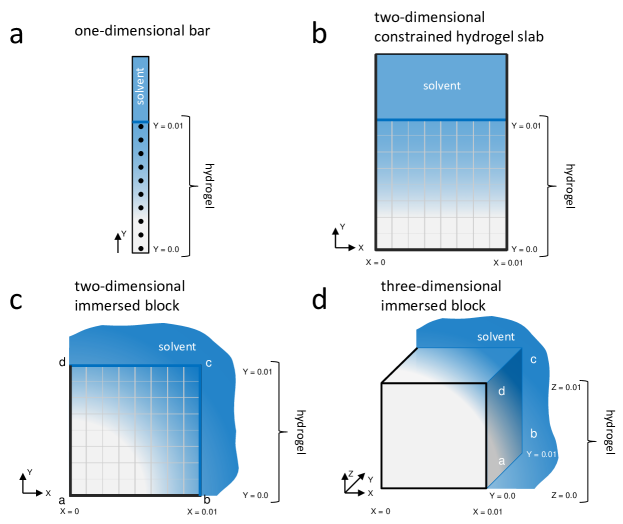
- ハイドロゲル構造におけるベンチマークシミュレーションを通じて、異なる体積応答仮定の下での結果を比較することで、フレームワークの妥当性を検証する。
実験結果
リサーチクエスチョン
- RQ1ハイドロゲルの有限変形・熱力学的に整合的な拡散-変形理論は、その数学的構造と物性的仮定の観点から、どのように比較できるか?
- RQ2体積応答モデルの選択、特にJ_fとc_R間の関数的依存関係が、予測される膨張および変形挙動にどの程度影響を及えるか?
- RQ3すべての検討対象理論を共通の熱力学的枠組みで回復できる統一的変分式を導出できるか?
- RQ4モノリシックおよびステージド有限要素法は、一時的かつ非線形でカップルドした化学的・機械的問題において、安定性および精度の観点でどのように性能を発揮するか?
- RQ5応力およびポテンシャル定義において、中間配置と現在配置の区別を無視した場合、どのような影響が生じるか?
主な発見
- 検討されたすべての理論は熱力学的に整合的であり、中間配置と自由エネルギーΨₑᴿ(Fₑ, cᴿ)に基づく単一の枠組みに統合可能である。
- 活性化学ポテンシャルμₐcₜ = ∂Ψₑᴿ/∂cᴿは熱力学的一致性を保証し、化学ポテンシャルと弾性応答を結びつける。
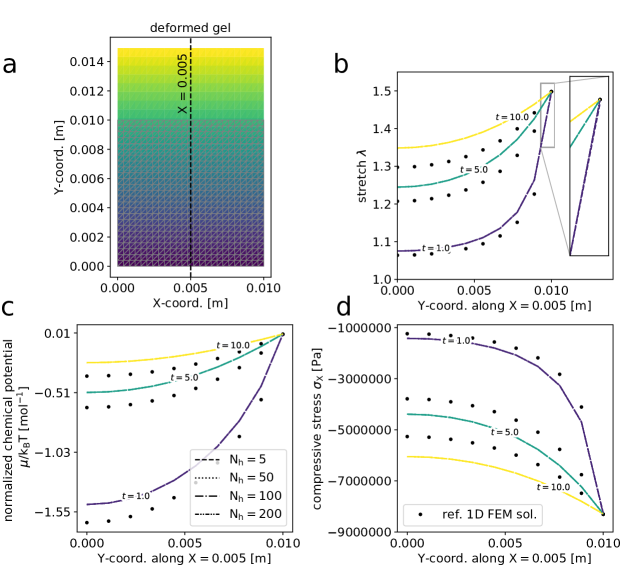
- 体積応答モデル、特にJ_f = (1 + Ωc_R)^{1/3}の関数的形が、予測される膨張挙動に顕著な影響を及ぼし、ベンチマークシミュレーションで顕著な差が観察された。
- Taylor-Hood要素はinf-sup条件を効果的に満たし、混合形式における不適切な圧力振動を防止した。
- モノリシックおよびステージド有限要素法の両方が一貫した解に収束したが、特に高い非線形領域ではモノリシックスキームがより優れた安定性を示した。
- 仮定された運動学的制約の下で、PK1応力テンソルP_eと元のP = ∂Ψ_R/∂Fの等価性が厳密に証明され、フレームワークの一貫性が裏付けられた。
この論文を読む
Nubintのビューアで原文を開き、読みながら気になる箇所をすぐに質問できます。
Nubintでこの論文を読むこのレビューはAIが論文の原文をもとに作成しました。引用する前に原文をご確認ください。