
[論文レビュー] Fluidisation of yield stress fluids under vibration
本研究では、垂直方向の正弦波振動下でヨークストレス流体としての溶けたチョコレートとカルボポールミクロゲルを用いて、振動によるフラUID化の挙動を調査した。両材料とも臨界駆動加速度を超えると拡散を示すが、カルボポールは大きな振幅の振動を伴いながらも、短時間で新しい平衡形状に緩和するのに対し、チョコレートは遅く、履歴依存的な拡散を示す。
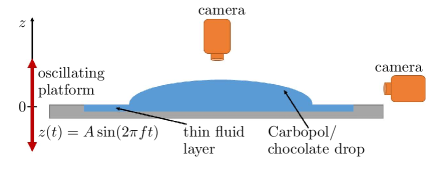
Motivated by the industrial processing of chocolate, we study experimentally the fluidisation of a sessile drop of yield-stress fluid on a pre-existing layer of the same fluid under vertical sinusoidal oscillations. We compare the behaviours of molten chocolate and Carbopol which are both shear-thinning with a similar yield stress but exhibit very different elastic properties. We find that these materials spread when the forcing acceleration exceeds a threshold which is determined by the initial deposition process. However, they exhibit very different spreading behaviours: whereas chocolate exhibits slow long-term spreading, the Carbopol drop rapidly relaxes its stress by spreading to a new equilibrium shape with an enlarged footprint. This spreading is insensitive to the history of the forcing. In addition, the Carbopol drop performs large-amplitude oscillations with the forcing frequency, both above and below the threshold. We investigate these viscoelastic oscillations and provide evidence of complex nonlinear viscoelastic behaviour in the vicinity of the spreading threshold. In fact, for forcing accelerations greater than the spreading threshold, our drop automatically adjusts its shape to remain at the yield stress. We discuss how our vibrated-drop experiment offers a new and powerful approach to probing the yield transition in elastoviscoplastic fluids.
研究の動機と目的
- チョコレートの工業的処理を背景に、垂直振動下におけるヨークストレス流体のフラUID化の力学的挙動を理解すること。
- 同じヨーク応力を持つが、異なる弾性特性を示す2種の剪切希釈性ヨークストレス流体(溶けたチョコレートとカルボポールミクロゲル)の拡散挙動を比較すること。
- ヨーク閾値付近での拡散の開始とダイナミクスに及ぼす粘弾性および駆動履歴の役割を調査すること。
- サイクルリオメトリーと応力ランプ法を用いて、カルボポールミクロゲルの動的ヨーク応力とヨーク後流動特性を同定すること。
- エラストビスコプラスティック流体のヨーク遷移をプローブするための新規な振動ドロップ実験を構築すること。
提案手法
- 垂直方向の正弦波振動下で、同じ流体の既存層上に静止滴としての溶けたチョコレートおよびカルボポールミクロゲルを用いた実験を実施した。
- 複数の周波数と振幅を用い、拡散の閾値を特定するため、駆動加速度を変化させた。
- 一定速度での応力ランプ(0.83–2.67 Pa/s)を用いたサイクルリオメトリック測定により、動的ヨーク応力とヨーク後流動曲線を決定した。
- 数値的逆問題解法を用い、リーマン型幾何配置における角速度から剪切速度を抽出したが、流動則モデルを仮定しないで行った。
- ヨーク後データをヘーシェル=バールクレー・モデルにフィットさせ、粘度と流れの挙動を定量的に評価した。パラメータは実験データから決定された。
- 上昇と下降の応力サイクル間のヒステリシスを分析し、トキソトロピーおよび粘弾性記憶効果を評価した。
実験結果
リサーチクエスチョン
- RQ1垂直振動下におけるヨークストレス流体の拡散を開始するために必要な臨界駆動加速度は何か?
- RQ2同じ振動駆動条件下で、粘性で弱い弾性を示す流体(溶けたチョコレート)と、高い弾性と剪切希釈性を示すゲル(カルボポール)とでは、拡散ダイナミクスにどのような差が生じるか?
- RQ3カルボポールの拡散挙動は、どの程度駆動履歴または事前剪切履歴に依存するか?
- RQ42.2 g/Lのカルボポールミクロゲルの動的ヨーク応力は何か?また、静的ヨーク応力と比較するとどうか?
- RQ5スティックスリップや大振幅振動といった粘弾性効果は、ヨーク閾値付近でのフラUID化プロセスにどのように影響を与えるか?
主な発見
- チョコレートおよびカルボポールの両方とも、臨界駆動加速度を超えると拡散を示すが、その閾値は初期の塗布プロセスに依存する。
- カルボポールは、新しい平衡形状に迅速かつ履歴に依存しない形で拡散し、拡大したフットプリントを示す。これは、粘弾性流動による応力緩和を示している。
- カルボポール滴は、拡散閾値の上下に関わらず、駆動周波数と同一の周波数で大振幅の振動を示しており、非線形粘弾性応答を示している。
- 2.2 g/Lのカルボポールミクロゲルの動的ヨーク応力は35 ± 3 Paで測定され、複数回の実験で一貫した値(35 ± 5 Pa)を示した。
- カルボポールのヨーク後流動挙動は、ヘーシェル=バールクレー・モデルで良好に記述され、2.2 g/L濃度ではK = 8.2 Pa s^nおよびn = 0.49 ± 0.02のパラメータが得られた。
- 上昇と下降の応力サイクル間のヒステリシスは最小限(5%以内)であり、テスト範囲内でトキソトロピーは顕著でないことが示された。
より良い研究を、今すぐ始めましょう
論文の読解から最終レビューまで、研究時間を劇的に削減しましょう。
クレジットカード登録不要
このレビューはAIが作成し、人間の編集者が確認しました。