
[論文レビュー] Gradient-free neural topology optimization: Towards effective fracture-resistant designs
本稿では、事前学習済みのラティント・ベルヌーイオートエンコーダー(LBAE)を用いて設計を低次元のラティンスペースに再パrameter化することで、勾配フリーなニューラルトポロジー最適化フレームワークを提案する。これにより、反復回数が10倍以上削減される。本手法は、勾配ベースの手法が失敗する非微分可能で亀裂に強い設計の最適化を効果的に行える。また、分布外問題への一般化性が強く、従来のブラックボックス最適化手法に比べて顕著な性能向上を示す。
Gradient-free optimizers allow for tackling problems regardless of the smoothness or differentiability of their objective function, but they require many more iterations to converge when compared to gradient-based algorithms. This has made them unviable for topology optimization due to the high computational cost per iteration and the high dimensionality of these problems. We propose a gradient-free neural topology optimization method using a pre-trained neural reparameterization strategy that addresses two key challenges in the literature. First, the method leads to at least one order of magnitude decrease in iteration count to reach minimum compliance when optimizing designs in latent space, as opposed to the conventional gradient-free approach without latent parameterization. This helps to bridge the large performance gap between gradient-free and gradient-based topology optimization for smooth and differentiable problems like compliance optimization, as demonstrated via extensive computational experiments in- and out-of-distribution with the training data. Second, we also show that the proposed method can optimize toughness of a structure undergoing brittle fracture more effectively than a traditional gradient-based optimizer, delivering an objective improvement in the order of 30% for all tested configurations. Although gradient-based topology optimization is more efficient for problems that are differentiable and well-behaved, such as compliance optimization, we believe that this work opens up a new path for problems where gradient-based algorithms have limitations.
研究の動機と目的
- 高次元トポロジー最適化問題における勾配フリー最適化の高い計算コストと遅い収束を解決すること。
- 特に亀裂のような非微分可能関数の最適化において、勾配フリー手法の次元の呪いとスケーラビリティの低さを克服すること。
- 勾配が不連続またはノイズが多い場合に勾配ベース手法が不適切となるような、複雑で滑らかでない目的関数(例:亀裂耐性)の効果的最適化を可能とすること。
- 事前学習済みLBAEを用いたラティンスプーリング最適化が、勾配フリーと勾配ベース手法の性能差を顕著に縮小できることを示すこと。
- 再訓練なしに、分布外問題や新しい物理的領域への一般化を検証し、ロバストネスと転送可能性を検証すること。
提案手法
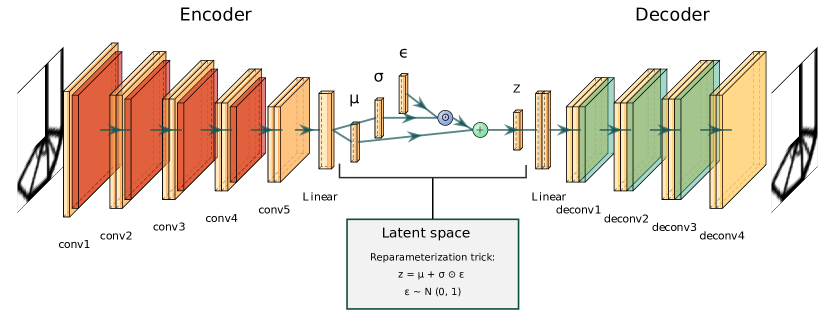
- 多様なトレーニング例からなる多様なトポロジー設計の分布を用いて、LBAEが低次元かつ分離可能なラティンスプーリング表現を学習する。
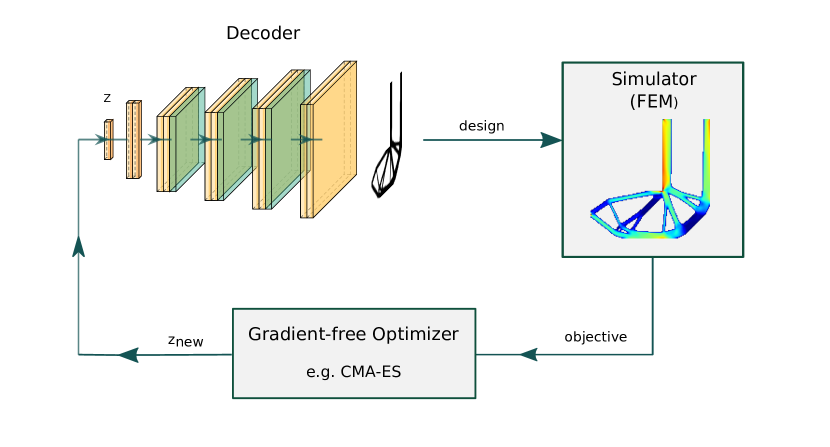
- LBAEのラティンスプーリングにトポロジー最適化問題を再パラメータ化することで、設計変数の次元を低減し、最適化の効率を向上させる。
- FEMシミュレーションによる性能評価に基づいて、ラティンスプーリング空間で勾配フリー最適化(CMA-ES)を用いて反復的に設計を更新する。
- ボリューム分率などのハード制約を、特定の制約値に対応する多様体に最適化を制限することで、ラティンスプーリング空間で強制する。
- 多様なボリューム分率とトポロジーを持つ設計の分布を用いてLBAEを学習することで、一般化性と表現力の向上を図る。
- 固定されたシミュレーション予算(FEM評価回数)を用いて性能をベンチマークするが、実際のウォルククロック時間を反映させるために並列で個体群を評価することを考慮する。
実験結果
リサーチクエスチョン
- RQ1事前学習済みオートエンコーダーによるラティンスプーリング再パラメータ化が、勾配フリートポロジー最適化における収束に必要な反復回数を著しく削減できるか?
- RQ2ラティンスプーリング最適化の性能は、従来のブラックボックス最適化と比較して収束速度および解の品質の面で優れているか?
- RQ3ある種のトポロジー問題(例:構造的剛性)で学習したモデルが、再訓練なしに分布外問題(例:熱的剛性最適化)に一般化できる程度はどの程度か?
- RQ4本手法が、勾配ベース手法が失敗する非微分可能関数(例:亀裂耐性)の最適化を効果的に行えるか?
- RQ5ラティンスプーリング表現が、複数の長さスケールにわたる多様な設計特徴をサポートできるか、それとも特定のトポロジー構造に偏りがあるか?
主な発見
- 提案手法によるラティンスプーリング再パラメータ化は、再パラメータ化なしの従来のブラックボックス最適化と比較して、収束に必要な反復回数を少なくとも10倍削減した。
- 最悪のケース(複数のランダム初期化からの最悪の実行)を考慮しても、LBAEベースの手法はベースラインを著しく上回った。
- 本手法は分布外問題への一般化が効果的であり、特に新しい物理的問題(熱的剛性最適化)に対しても、勾配ベースのベースラインと同等の性能を達成した。
- トレーニングデータとは顕著に異なる特徴を持つ設計に対しても、モデルは有望な一般化を示しており、ロバストネスと転送可能性を示している。
- 現在のアプローチは特定の特徴長さスケールに偏りを示しているため、より表現力の高いアーキテクチャや、ラティンスプーリング空間における制約強化の改善により、解の多様性をさらに向上できる可能性がある。
- 勾配情報が欠如しているにもかかわらず、特に亀裂耐性設計においては勾配ベース手法と同等の性能を達成しており、非微分可能な設定でも有効であることが示された。
より良い研究を、今すぐ始めましょう
論文の読解から最終レビューまで、研究時間を劇的に削減しましょう。
クレジットカード登録不要
このレビューはAIが作成し、人間の編集者が確認しました。